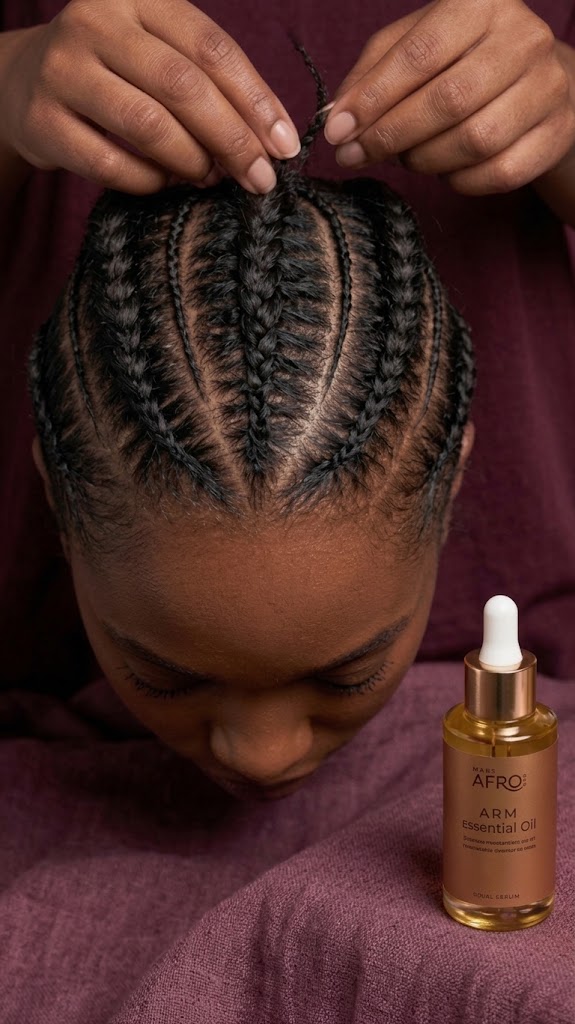
The standard
A protective style should reduce daily manipulation without creating pain, excessive weight, repeated friction, hidden matting or difficult scalp care. If the hairline, scalp or takedown pays the price, the style has not protected the whole system.
A beautiful finished result can hide an expensive trade-off. Pain, bumps and a tightly pulled hairline are not signs that a style will last; they are signals to stop and adjust.
Protection begins before the appointment
Install on hair and scalp that are clean enough to monitor. Detangle gently, remove shed hair and avoid stacking several stressful processes together. Fresh chemical treatment, high heat, aggressive brushing and tight extensions in the same period can leave the fibre with little margin for error.
Choose the style according to density, strand size, current breakage and the condition of the hairline—not only the reference photograph. Very long or dense extension hair adds weight. Small sections can concentrate that weight on fewer strands.
The installation audit
- No pain standard.You should not need painkillers, a sleepless night or several days for the style to “loosen.” Ask for tension to be reduced immediately.
- Hairline restraint.Short, fine hairs around the temples and nape do not need to be captured for the style to look finished.
- Weight check.Tilt and turn your head before leaving. If the style pulls at rest, it will not become lighter at home.
- Parting and access.You should be able to see enough of the scalp to cleanse, dry and notice irritation without dismantling the style.
- Attachment check.Combs, clips, thread, glue and elastic should not repeatedly rub or pull the same fragile area.
Signals that require action
| Signal | What it may mean | What to do |
|---|---|---|
| Persistent pain or headache | Excess tension or weight | Loosen or remove the responsible sections; do not wait for pain to become normal |
| Bumps, redness or tenderness | Inflammation, irritation or traction | Stop tension and seek qualified advice if symptoms persist or worsen |
| Hairline hairs pulled flat and shiny | Too much tension at vulnerable margins | Release the edges and avoid slicking them back throughout wear |
| Strong odour or dampness after washing | Incomplete drying or trapped residue | Improve access and drying; remove the style if the scalp cannot be kept clean and dry |
| Loose roots with matted new growth | Shed hair, residue and extended wear | Plan a careful takedown rather than tightening or extending the style |
Care during wear should stay simple
Cleanse according to sweat, activity, scalp comfort and product use. Focus cleanser on the scalp, rinse thoroughly and dry fully. Layering oil over itching or residue can make the scalp harder to assess. “Scalp oiling” is not a substitute for cleansing or evaluation of persistent symptoms.
Reduce friction at night with a smooth scarf, bonnet or pillowcase that does not add pressure. Avoid repeatedly gathering braids into the same high, tight position; the style can be low-tension at installation and become stressful through daily handling.
Takedown is part of the protective style
Set aside enough time. Cut extension hair well below the point where your own hair ends, then undo the style section by section. Remove shed hairs and loosen accumulated debris with fingers before introducing water. Wetting a compacted section too early can tighten tangles.
Use slip, smaller sections and patience. A large ball of shed hair can be normal after several weeks because hairs that would usually fall daily remained trapped. Short snapped pieces, thinning edges and sparse patches tell a different story and deserve attention.
When to retire the style
- The scalp cannot be cleaned or dried properly.
- New growth is matting, locing unintentionally or collecting heavy residue.
- The style has become loose enough to swing and pull on individual sections.
- There is pain, persistent itching, inflammation, sores or visible thinning.
- Maintaining the appearance now requires repeated tightening or heavy edge control.
Dermatology literature recognises prolonged or repetitive tension from styling as a risk factor for traction alopecia. Early changes may be reversible, while sustained traction can lead to permanent loss. That is why comfort and the hairline deserve attention before the style looks visibly damaged.
Can this style be worn without pain, cleaned and dried, varied during daily wear, and removed without rushing? If one answer is no, redesign the style before it reaches your hair.