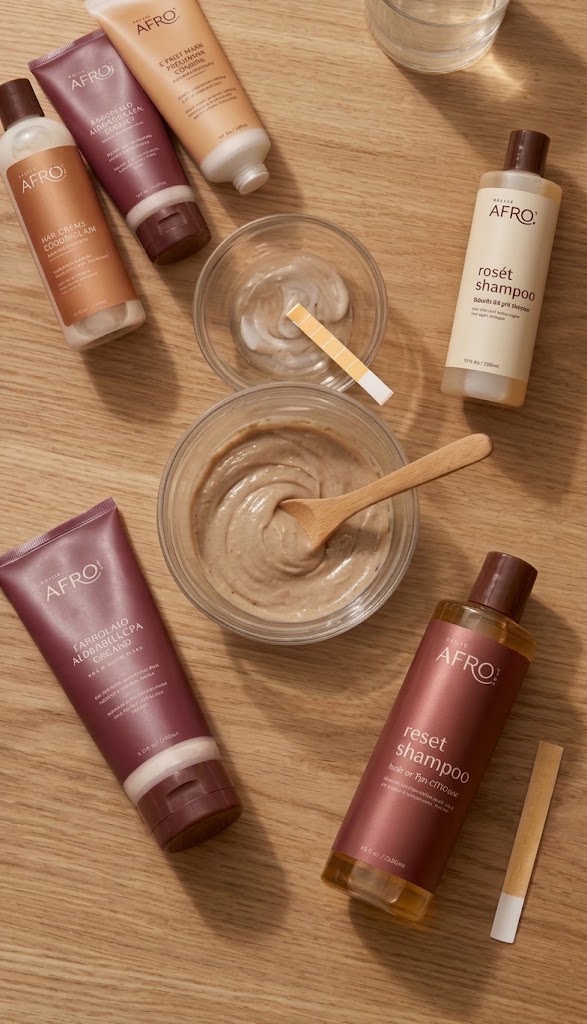
The reset logic
First remove enough residue to create a fair starting point. Then use one conditioner and the minimum styling combination needed for the result. Observe wet feel, dry feel, flaking and day-three manageability before adding anything back.
When a favourite product suddenly seems useless, the product may not have changed. The surface it is being applied to—and the products underneath it—may have.
What people call buildup
Buildup is the accumulation of material that ordinary washing has not sufficiently removed. It can include oils, butters, polymers, waxes, dry shampoo, edge control, styling residue, environmental particles and minerals from water. The issue is not that every film is bad: conditioners and stylers are designed to leave useful material behind. The issue is when accumulated film interferes with cleansing, wetting, conditioning, styling or scalp comfort.
Hair may feel greasy and dry at the same time because coating and flexibility are different. Adding another butter can make the surface feel heavier without addressing stiffness or poor water distribution.
Read the signals in sequence
| What you notice | Check | First experiment |
|---|---|---|
| Water beads and takes longer to saturate hair | Heavy stylers, oils, waxes or mineral deposits | Use a more thorough cleanser, then test without pre-oil |
| Conditioner no longer gives slip | Surface coating, formula change or insufficient water | Reset the surface and add water during conditioning |
| White flakes appear only after styling | Product incompatibility or excessive quantity | Test the leave-in and gel together in your palm, then apply less |
| Hair feels waxy, dull or unusually stiff | Layered butters, edge control or incomplete cleansing | Simplify to cleanser, conditioner and one styler |
| Scalp remains itchy after oiling | Residue, irritation or an underlying scalp condition | Stop layering, cleanse gently and seek advice if symptoms persist |
Clarifying is a function, not a punishment
A clarifying wash uses enough cleansing power to remove more persistent residue than your regular wash. It should not require scratching the scalp or repeatedly shampooing until the hair squeaks. The right frequency depends on product use, water, sweating, swimming and how effective the regular cleanser is.
If you use water-resistant stylers, heavy oils, waxy edge products or frequent co-washing, you may need periodic stronger cleansing. If your routine is light and your regular shampoo cleans effectively, a separate clarifier may be unnecessary.
A controlled one-wash reset
- Choose the cleanser deliberately.Use a thorough shampoo appropriate to your residue level. Focus on the scalp and allow lather to move through the lengths.
- Rinse longer than usual.Dense hair and protective styles can trap both product and cleanser. Work in sections and verify that the water runs through each one.
- Condition for slip.Use one familiar conditioner, add water and detangle gently. Do not turn the reset into a five-treatment event.
- Use one styling system.Choose a leave-in plus gel, or one cream styler, based on the job. Measure roughly how much you use.
- Observe for several days.Record softness, hold, flaking, transfer, tangling and how easily the next wash begins.
Compatibility matters more than ingredient folklore
Two individually good products can perform poorly together. A leave-in and gel may form visible clumps in the palm or flake after drying. Too much cream under a strong-hold gel can weaken hold. Oil applied before a water-based product may make distribution uneven.
The palm test is not perfect, but it can reveal obvious clumping before the products reach your whole head. More importantly, change one pairing at a time. If you replace the cleanser, conditioner, leave-in and gel together, you will not know which decision helped.
When the problem is not ordinary buildup
- Persistent flakes may relate to a scalp condition rather than styling residue.
- Greenish, rough or discoloured hair after swimming may need attention to mineral or metal exposure.
- Sudden breakage after chemical or heat processing is not solved by repeated clarifying.
- Pain, sores, marked redness or patchy loss deserves qualified professional assessment.
Give every bottle a defined role
Keep products that do a repeatable job: cleanse, condition, support detangling, provide hold, reduce friction or create a finish you value. A product does not earn its place because it contains a fashionable ingredient or because you paid for it.
After the reset, add back only what solves a problem you can name. A simpler routine is easier to assess, easier to repeat and often easier on the budget.
For every product, complete the sentence: “I use this to…” If two products have the same answer—or one has no answer—test the routine without one of them.