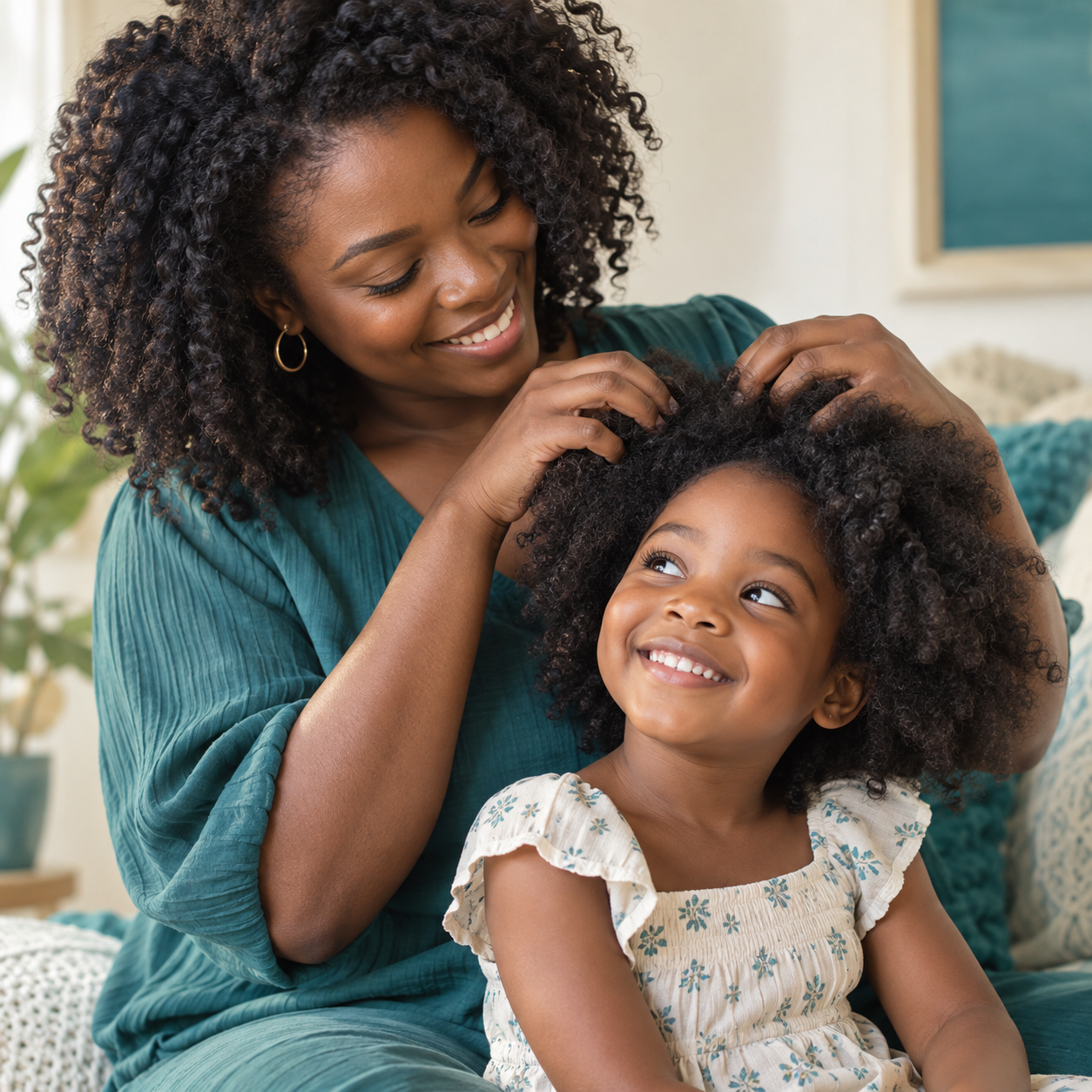
The principle
Detangling should rely on preparation, water, slip, sections and patience—not endurance. When a child knows what comes next and can ask for a pause, hair care becomes a shared skill rather than something done to them.
Children remember how hair care feels. A technically neat style is not a success if every wash day teaches the child that their texture is difficult, painful or a problem for adults.
Make the sequence predictable before touching the hair
Resistance is not always about the hair. The child may be tired, hungry, cold, bored or remembering a painful session. Explain the sequence in simple language: “We will wet your hair, add conditioner, make sections, loosen the tangles, rinse and choose the style.” For younger children, show the tools in the order you will use them.
Prepare everything first: clips, spray bottle, conditioner, towel, detangling tool and the styling products you actually need. Searching for a comb while a child waits with wet hair turns a manageable routine into a long one.
The detangling sequence
- Start with damp, conditioned hair.Hair should be wet enough to bend easily. Add conditioner with good slip and distribute it before reaching for a tool.
- Create working sections.Four to eight sections are common, but the right number is the one that lets you control the hair without repeatedly mixing detangled and tangled strands.
- Remove obvious tangles with fingers.Separate shed hairs, gently open large knots and feel where resistance begins. Fingers give information that a tool cannot.
- Support the hair above the tangle.Hold the section so the pulling force is not transferred directly to the scalp. Begin at the ends and move upward in small increments.
- Secure the finished section.Twist or braid it loosely so it does not shrink back into neighbouring hair while you work elsewhere.
Let slip do more work than your hands
“Slip” describes how easily strands move past one another when wet and conditioned. If a section is resisting, the answer is rarely to repeat the same stroke with more force. Add water, add a small amount of conditioner, reduce the section size and try again.
For a compact knot, hold it between your fingers and gently pull individual strands away from the outside. A pointed tail comb can sometimes help isolate strands, but it should not be used to saw through the knot. If a knot cannot be released without breaking several strands, carefully cutting only the knot may preserve more hair than prolonged tearing.
Choose tools by behaviour, not marketing
| Tool | Useful when | Watch for |
|---|---|---|
| Fingers | Finding knots, separating shed hair, protecting fragile areas | Sharp nails or rushing through very small tangles |
| Wide-tooth comb | Controlled detangling in clearly separated sections | Starting at the roots or using teeth with rough seams |
| Flexible detangling brush | Distributing conditioner and working through larger sections | Too many passes, packed shed hair or a brush that bends without releasing tangles |
| Sectioning clips | Keeping completed hair separate and the process organised | Clips that pinch, snag or are too tight at the scalp |
Use language that protects confidence
Avoid “bad,” “rough,” “wild,” “stubborn” and “impossible.” These words can become the child’s internal description of their own hair. Describe the task instead: “This section needs more water,” “There are shed hairs caught here,” or “We need a smaller section.” The technique can be difficult without the texture being wrong.
Offer age-appropriate choices: which section to start with, the colour of the clips, the final style or when to take a short break. Choice does not mean the routine has no boundaries; it gives the child meaningful participation.
Prevent the knots you can prevent
- Keep hair contained between wash days. Loose hair can be beautiful, but repeated friction and shrinkage may require more detangling later. Use loose braids, twists or puffs when helpful.
- Protect hair at night. A comfortable satin bonnet, scarf or pillowcase can reduce friction. Comfort matters; a child will not keep wearing something hot, tight or irritating.
- Remove styles before matting begins. Extending a style past the point where shed hair is trapped can make takedown much harder.
- Do not postpone every tangle until wash day. If a style is becoming knotted, address the affected section gently rather than allowing several days of additional friction.
What to do when the child becomes overwhelmed
Stop. A short pause is more efficient than continuing while the child moves, cries or braces against pain. Check whether the hair needs more water, whether the section is too large or whether the child simply needs the session divided into two parts.
Sudden scalp tenderness, sores, significant hair loss or persistent flaking should not be treated as a behaviour problem. Avoid tight styling and seek appropriate professional advice.
The child should be able to describe what is happening, request a pause and finish the routine without hearing that their hair is the problem.